

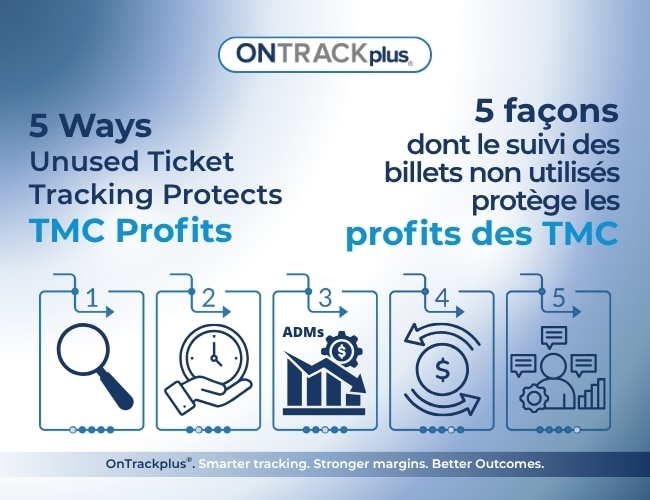
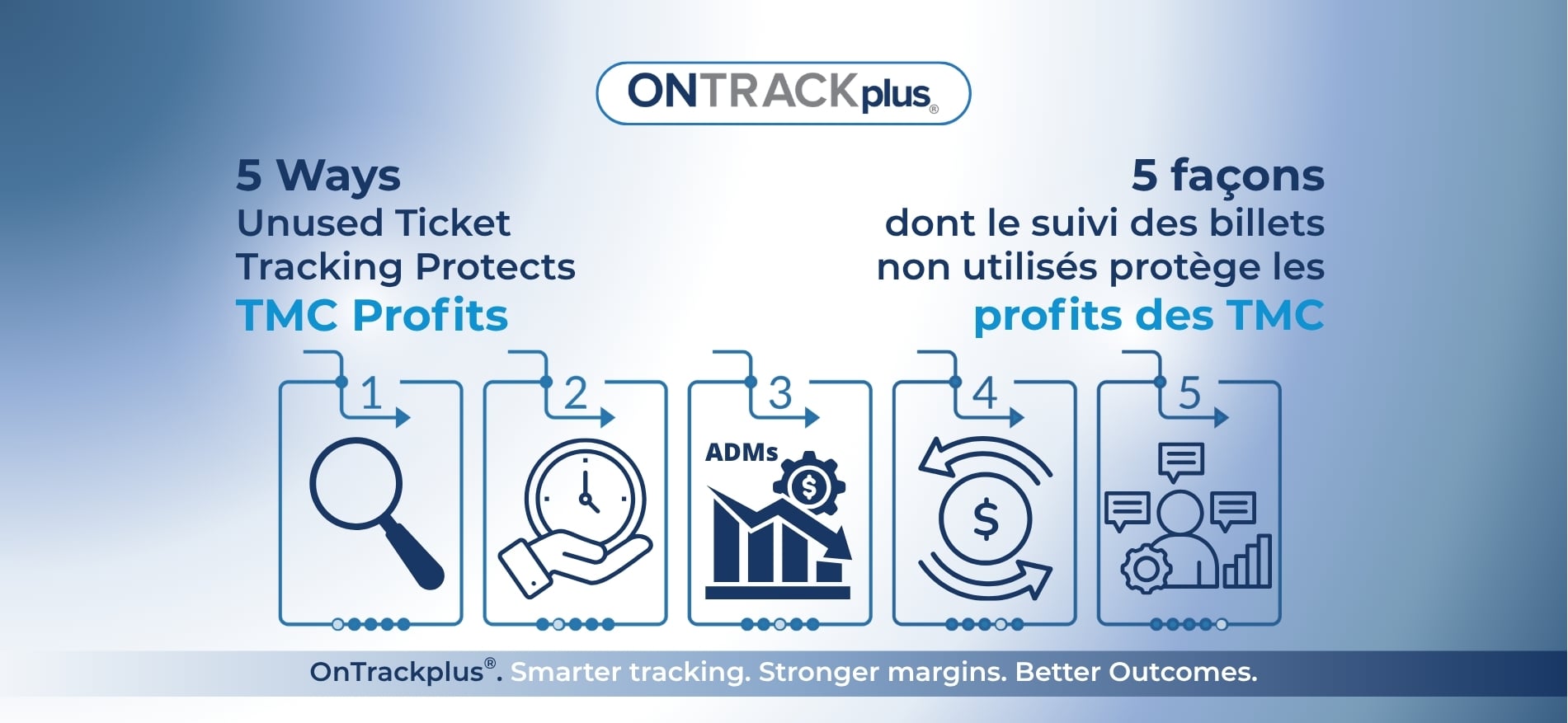
Five Ways Automated Credit Tracking Protects TMC Margins and Delivers Client Value
Montreal, Canada — 3 August 2026 —
Magnatech® Travel Management Solutions Protect TMC Margins Five Ways with OnTrackplus®
In the highly competitive landscape of corporate travel management, Travel Management Companies (TMCs) balance a delicate equation: maximizing value for corporate clients while protecting their own operational margins.
For years, one of the quietest yet most persistent drains on both sides of this equation has been the management of unused airline tickets. A commonly cited industry estimate suggests that approximately 5% of corporate airline tickets go completely unused. When the resulting credits are not identified, monitored and applied before they expire, they represent a significant source of avoidable financial loss for corporate clients.
They also create operational and commercial risk for the TMC.
Historically, TMCs have relied on retrospective spreadsheets, manual consultant audits, or siloed Global Distribution System (GDS) reports to manage unused tickets and credits. However, as airline distribution becomes more complex and booking volumes grow, manual tracking is no longer simply inefficient: it increases the risk of missed credits, calculation errors, inconsistent servicing and limited client visibility.
Magnatech’s OnTrackplus® platform was developed specifically to transform credit management from a reactive, labour-intensive chore into an automated, revenue-protecting asset. Backed by real-world agency performance, we break down the five key pillars where automated tracking delivers immediate, measurable ROI for TMCs and their corporate clients.
1. Delivering Client Savings Through a Frictionless Ecosystem
The traditional approach to unused credits (a monthly or quarterly spreadsheet of a client’s unredeemed credits) is inherently retrospective. By the time the client reviews the report, new bookings have already been made using fresh capital, and older credits are left to creep closer to their expiration dates.
OnTrackplus flips this model on its head by focusing on a more proactive approach by making current credit information available within the technologies TMCs and their clients already use.
For Sabre-connected TMCs, OnTrackplus also automates the tracking of EMD-A and EMD-S available through the GDS, extending visibility beyond unused tickets to credits associated with ancillary services and other travel-related transactions.
Rather than requiring travel consultants to open another system or run a separate manual query, OnTrackplus operates as a centralized credit data engine — the unused ticket source of truth, if you will. It identifies, calculates, monitors and distributes unused ticket information to the relevant booking and profile environments. Credit information can be integrated into any proprietary system using our Unused Ticket API Library as well as automatic integration with GDS profiles, booking technologies such as Online Booking Tools (OBTs), BookingBuilder and profile management platforms including Kudos and Umbrella, to name a few. Magnatech’s own quality control solution, MTWorkflows®, is also integrated with OnTrackplus for those TMCs resolved to maximize credit application before a new online or offline booking is ticketed.
All these options mean an available credit can be identified at the point when a new booking is being considered, rather than passively discovered weeks or months later in a spreadsheet.
By presenting live credit availability at the precise moment a booking is initiated, OnTrackplus ensures that credits are actually applied before they expire, translating directly into hard-dollar savings for your corporate accounts.
2. Returning Valuable Time to Travel Consultants

The travel industry continues to face severe talent constraints and agent capacity issues. In a manual environment, corporate travel consultants may spend hours auditing tickets, verifying airline credit conditions, calculating residual values and searching for documents that could potentially be reused. At the same time, account managers can spend days every month gathering, validating and reporting on the same unused tickets, also known as tickets on hold. Every minute an experienced consultant or account manager spends playing data detective is a minute they are not spending delivering high-value service, supporting travellers, managing complex bookings, strategizing refinements or strengthening client relationships.
OnTrackplus not only automates the finding, tracking and calculation of unused tickets, it also automates the reporting of them. These reports are customised then scheduled so every client gets exactly what they want to see in their reports at a frequency that suits them. But it doesn’t stop there. OnTrackplus reports are also a valuable internal tool to help agencies manage missing fields, expiry dates and even report on exchanged, refunded and expired credits to help demonstrate TMC value and continually improve performance. The adage, What gets measured gets managed, applies here.
The operational return on automation therefore can be massive. As highlighted in our published case study with Goldman Travel Corporation, the agency revealed that implementing OnTrackplus saved approximately 2 days of work per month for each business manager and 1 day per month per consultant.
Cumulatively, the investment in OnTrackplus returned 27 days’ worth of operational activity back to their team every single month. Automation also helped remove the uncertainty associated with manual ticket calculations. Rather than different consultants arriving at different answers, the agency gained a more consistent and standardized process.
By reducing the administrative workload associated with unused tickets, TMCs can support higher transaction volumes and larger corporate accounts without requiring a corresponding increase in back-office resources.
Just as importantly, experienced consultants can focus more of their time on the work that clients value most.
3. Drastic Reduction in Costly Agency Debit Memos (ADMs)
Airline distribution and ticket servicing have never been more complex.
The rapid acceleration of New Distribution Capability (NDC) content alongside traditional EDIFACT bookings means that exchange conditions, residual value rules and servicing requirements can vary wildly by carrier and distribution channel.
Incorrectly calculated or applied credits can lead to punitive Agency Debit Memos, particularly when a ticket has been partially used or a credit has already been exchanged or refunded. For a TMC operating on fixed transaction or management fees, even a small number of significant ADMs can materially reduce the profitability of a corporate account.
OnTrackplus helps reduce this risk by identifying both full and partial credits, recognizing which segments remain open and calculating the corresponding available value. This gives consultants a clearer and more consistent basis for applying the credit correctly.
The system also helps prevent duplicate usage. Once a credit is exchanged or refunded, OnTrackplus automatically updates connected Online Booking Tools, profile platforms and reporting tools so it no longer appears available for future bookings.
Consultants continue to apply their expertise by reviewing the relevant fare conditions before processing an exchange or refund. OnTrackplus® supports this process by improving credit calculation, helping ensure accurate application and removing used credits from the wider booking ecosystem. Together, these controls help TMCs reduce servicing errors and protect their margins from avoidable ADMs.
This was demonstrated in Magnatech’s recent case study with Chicago-based TravelexBiz. By integrating OnTrackplus into their booking and profile environment, TravelexBiz improved the visibility and application of available credits, helping to reduce costly servicing errors and ADMs.
The agency reported savings of approximately US$3,000 to US$5,000 per month through fewer servicing errors and resulting ADMs.
By reducing reliance on individual manual processes and replacing them with standardized data automation, OnTrackplus directly protects the TMC’s bottom line while supporting more accurate and consistent client servicing.
4. Converting Unused Credits into Flown Value
Preferred airline agreements can represent an important part of a TMC’s commercial strategy, while corporate clients may also have route, volume or market-share commitments with their chosen carriers.
When an unused ticket expires, the remaining value is lost by the client and retained by the airline. Ironically, despite keeping the ticket value, the airline doesn’t consider unflown flights as contributing towards preferred-carrier targets, override agreements or corporate route commitments.
In this respect, an unused corporate credit is similar to an expiring gift certificate. The value has already been paid, but unless it is identified and used within the permitted period, neither the client nor the TMC receives the intended benefit, meanwhile the airline amasses the revenue.

OnTrackplus helps prevent this value from being overlooked by making eligible credits visible when new travel is being booked. Where the itinerary, fare conditions and supplier agreement align, the credit (minus any exchange fees) can be applied towards a new journey, returning value to the corporate client and converting an otherwise dormant document into flown activity.
By helping agencies turn expiring credits into completed travel, OnTrackplus supports client savings, supplier performance and an important area of TMC commercial revenue.
5. Elevating Due Diligence and Transparency to Win the Corporate RFP
Corporate procurement and travel buyers have become increasingly risk-conscious. These days, Requests for Proposals (RFPs) no longer focus solely on transaction fees; they also scrutinize a TMC’s internal controls, data security and financial transparency. Recent industry scrutiny involving accounting discrepancies and unreturned client funds has further heightened expectations around how unused tickets, exchanges, cancellations and refunds are managed.
A typical RFP may ask how unused credits are identified, tracked, applied and reported, as well as what controls are in place to prevent duplicate use and provide an accurate audit trail. For agencies relying on spreadsheets, siloed systems or individual consultant processes, these questions can be difficult to answer consistently.
OnTrackplus serves as a powerful due diligence engine that directly answers these strict RFP requirements. By completely automating the process of finding, calculating, tracking, and reporting on unused tickets, the platform drastically reduces the risk of human oversight or misrepresentation. GDS-originated credits are identified, calculated, monitored and updated through a consistent process, while integrations with booking and profile platforms help ensure that used credits no longer appear once they have been exchanged or refunded. Credits originating outside the GDS can also be added and maintained within the same centralized system.
Detailed system-generated reporting provides a transparent and auditable record of available, exchanged, refunded and expired credits. This enables agencies to demonstrate:
-
- consistent, automated credit-tracking processes
- reduced reliance on spreadsheets and manually maintained records
- clearer and more accurate client reporting
- greater visibility into available and processed credits
- documented controls around ticket exchanges and refunds
When competing for corporate business, this transparency can become a meaningful differentiator.
This is all supported by Magnatech’s best-in-class, purpose-built technology and its commitment to strong data-security and operational controls. Magnatech has achieved SOC 2 Type II certification, providing additional assurance around the systems and processes used to protect client data.
When pitching for corporate, government or public-sector business, a TMC can therefore do more than state that unused credits are monitored. It can speak to the automated governance framework used to protect client value. This strengthens the agency’s RFP response and positions the agency as a trusted, highly transparent partner that corporate stakeholders can rely on.
The Strategic Takeaway
Technology creates the greatest value when it works within the systems that consultants and corporate travellers already use.
Leaving unused ticket management to manual workflows, disconnected spreadsheets or standard GDS queues can result in expired credits, unnecessary administrative work, calculation errors and reduced client confidence. OnTrackplus provides scalable, automated credit-management infrastructure designed specifically for the corporate travel industry.
By integrating credit information into existing booking, profile and reporting environments, it helps TMCs:
-
- reduce avoidable client losses
- return valuable time to consultants and account managers
- lower the risk of servicing errors and ADMs
- support preferred-supplier performance
- strengthen transparency in corporate sales and RFP processes
Unused ticket management may operate behind the scenes, but its impact is highly visible. For corporate clients, it affects whether valuable credits are recovered or left on the table to expire. For TMCs, it affects productivity, profitability, supplier relationships and the ability to demonstrate reliable financial controls.
Automating the process turns credit management from an administrative burden into a measurable source of operational and commercial value.
Join the OnTrackplus® Revolution
Discover how easily OnTrackplus integrates with your existing GDS, OBTs, and profile platforms. Contact the Magnatech team today to schedule a tailored demonstration and unused ticket tracker ROI assessment.